FrontPage
FrontPage | Project Team Member | Presentations | Publications | Patents | Grants | Awards | Project History | Photos | Videos
About Project
_ CTガイド下Interventional Radiology(IVR)とは
IVRは、日本語で言うと「画像下治療」という意味です。
すなわちCTガイド下IVRとは、医師がCT画像を見ながら病変部に針を刺入して、
がんを焼いたり凍らせたりして治療を行うことです(図1)。
_ What is CT-guided Interventional Radiology?
CT-guided interventional radiology includes cancer ablation that physicians may perform
by inserting a specific needle into a lesion during CT scanning and confirming CT images
(Fig. 1).
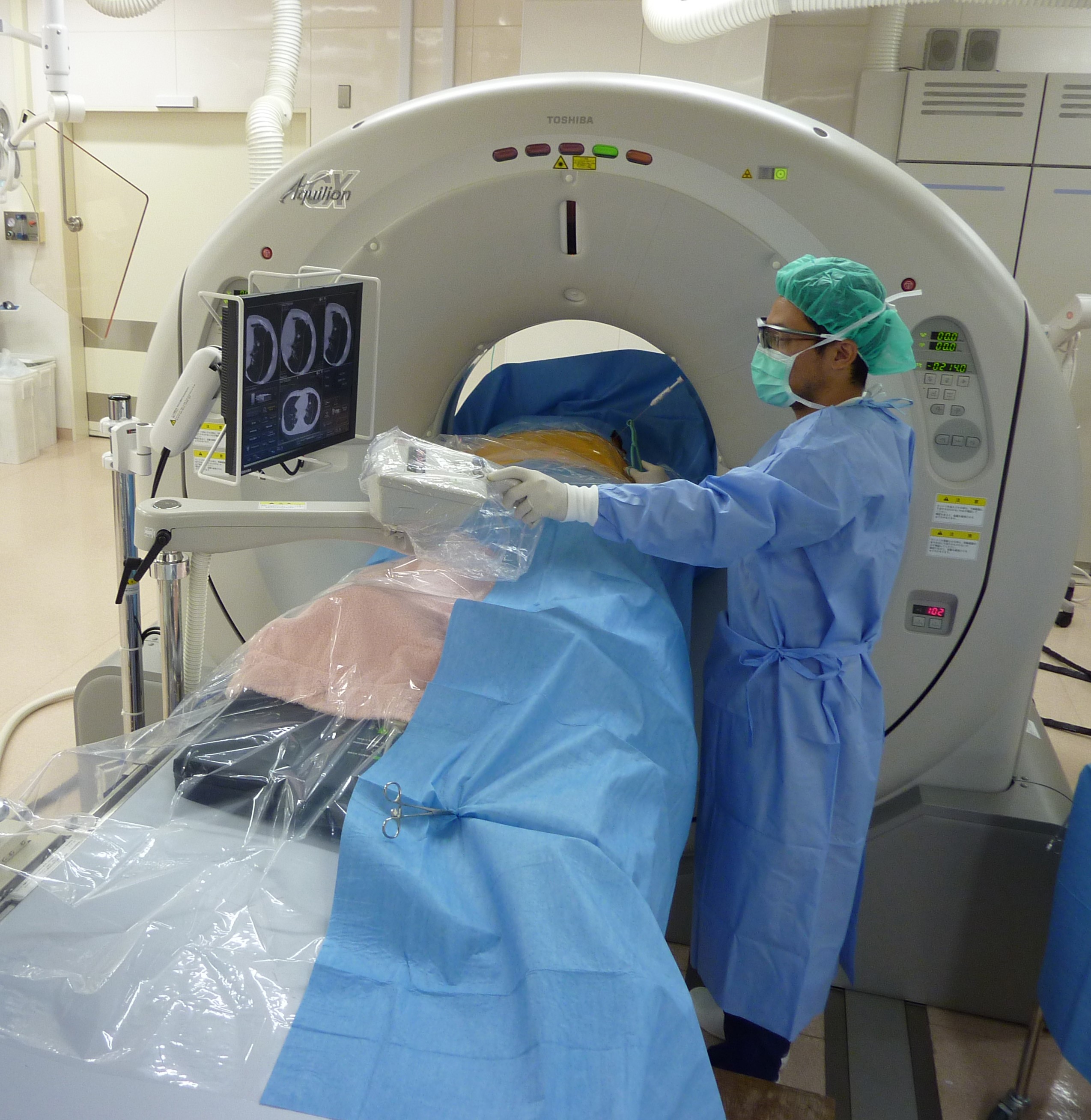
図1.CTガイド下IVR中の様子
Fig. 1 (A picture of conventional CT-guided interventional radiology)
_ CTガイド下IVRの利点と欠点
CTガイド下IVRの利点としては、針を刺入するだけでがんの治療ができるため
患者さんの体にやさしいことが挙げられます。
また医師がCT画像を見ながら治療を行うため、病変部に最短距離でアプローチでき、
治療時間が短くて済みます。
そのため超高齢の患者さんや併存症がある患者さんでもがんの治療が可能です。
また手術と比べるとはるかに安価です。
一方で、欠点としては、CTを用いるため患者さんや医師が被ばくしてしまうことがあります。
特に、日々多数の患者さんの治療を行っている医師にとっては積み重なる被ばくは
重大な懸念となっています。
_ Pros and Cons of CT-guided Interventional Radiology
CT-guided interventional radiology has advantages over surgery, in terms of faster, less invasive,
and less costly procedures.
Therefore, it may be applied to the patients who are oldest-old and/or have comorbidities.
On the other hand, the most substantial disadvantage may be radiation exposure to physicians
who have to perform the procedure close to CT.
_ 本プロジェクトの目的
本プロジェクトでは、2012年から遠隔操作でCTガイド下に針刺入を行うロボット(Zerobot®)の開発を
医工連携・産学連携で行っています(図2)。
医師はCT装置から離れて治療ができるため、医師の被ばくはほぼZeroになります(図3)。
_ Purpose of Project
Since 2012, we have been developing a remote-controlled robot (Fig. 2) to enable needle insertion
under CT-guidance along with medical-engineering cooperation and industry-academia collaboration.
With the robot, physicians can perform the procedure apart from CT without being exposed to radiation (Fig. 3).
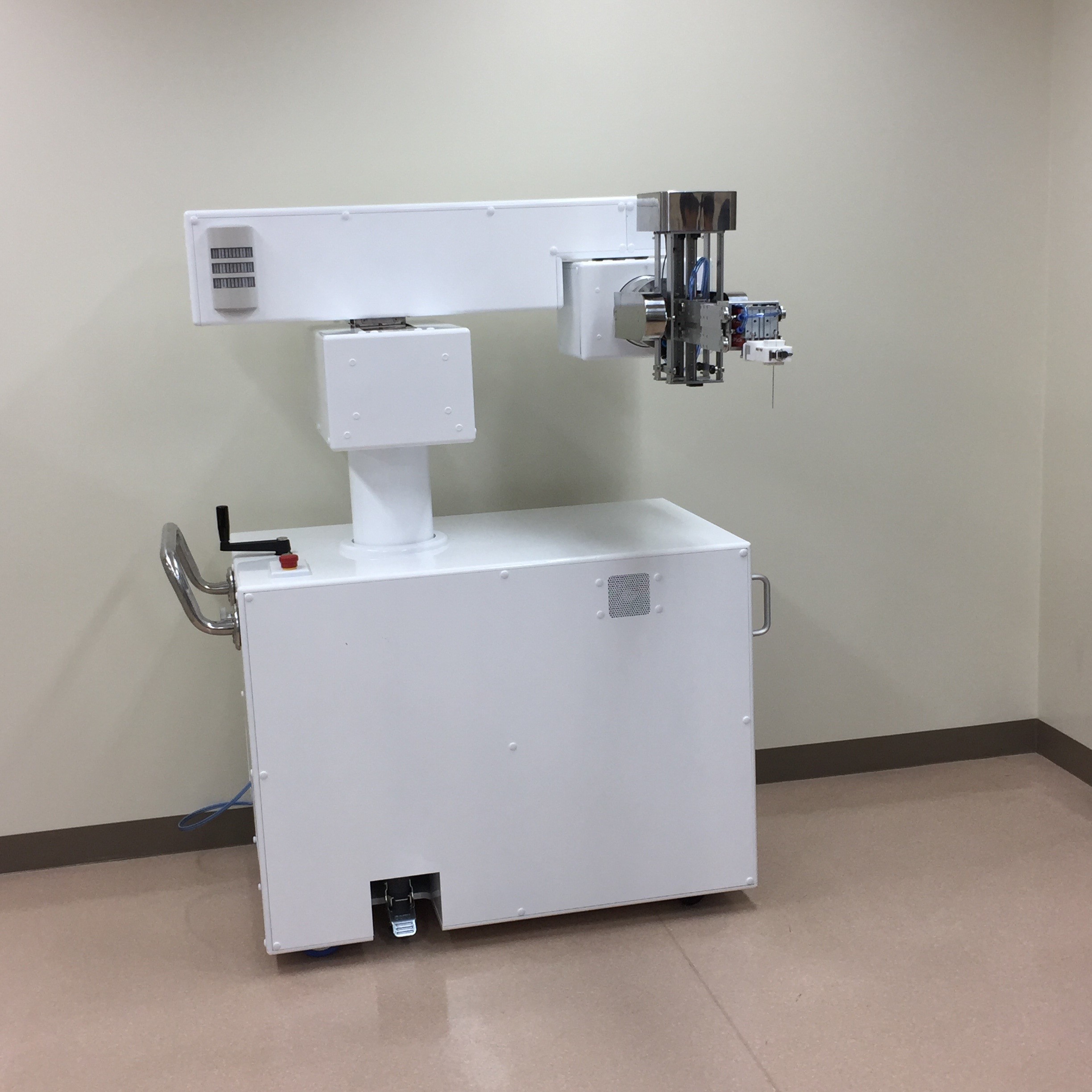
図2.Zerobot®
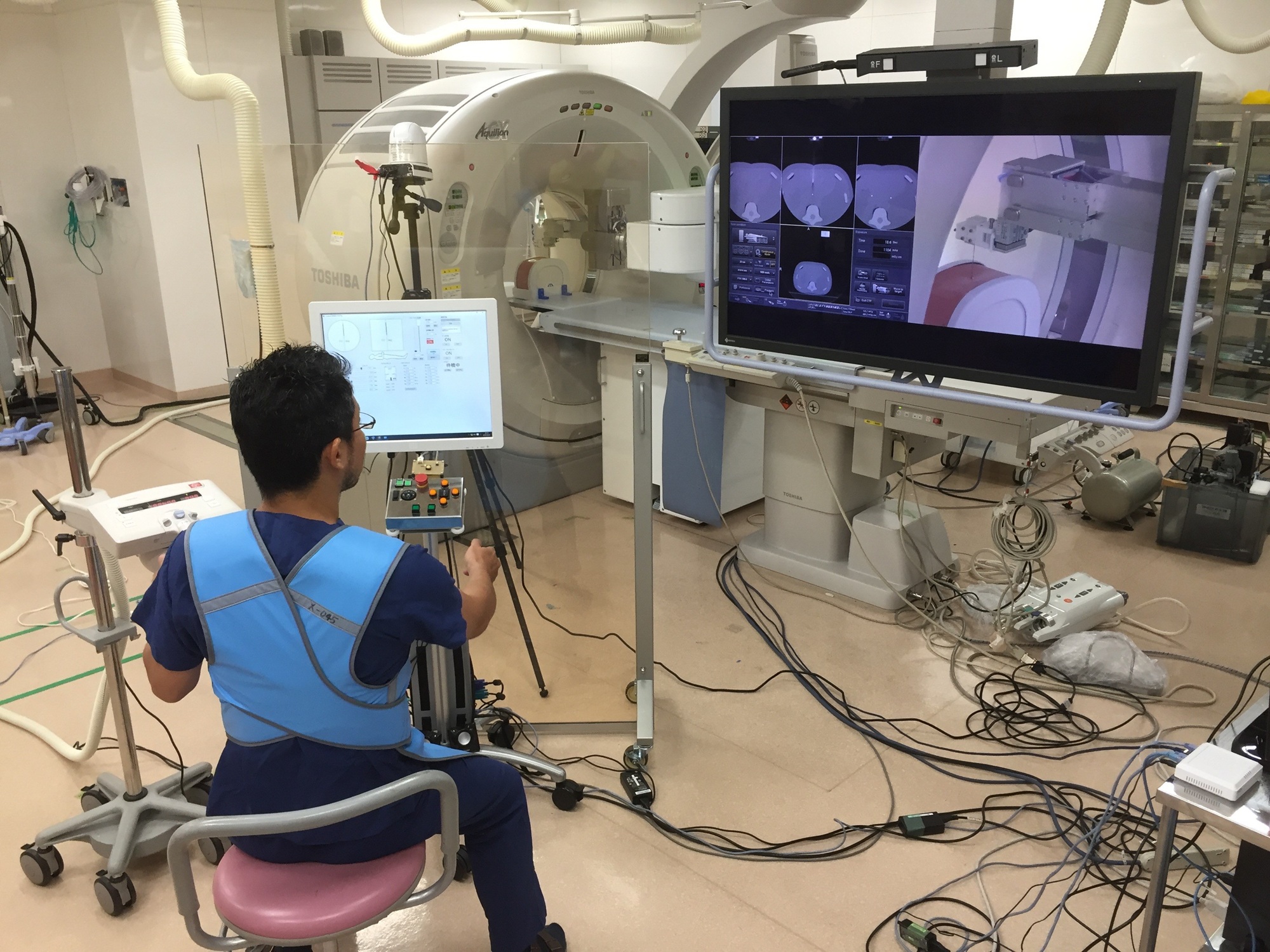
図3.Zerobot®を用いたCTガイド下IVR(ファントム試験)中の様子
(A picture of CT-guided interventional radiology with the use of Zerobot® during phantom experiments)
現在までに行った前臨床試験1, 2, 3)および臨床試験4)の結果、
Zerobot®を使えば、医師は被ばくすることなく、高精度に針の刺入ができることが確認されています。
またそれ以外にもZerobot®には様々な利点があります。
例えば、人の手より力が強く、また手ブレしないため、針の姿勢が安定しており、
針刺入時に直進性がすぐれていることが挙げられます。
また車の自動運転のようにZerobot®による手技の自動化も可能と思われます。
我々は、そのような利点を活かし、人の手を超えた治療を実現し、医師だけでなく、
患者さんにとってもメリットのあるロボティックIVRを目指しています。
Our previous preclinical experiments1, 2, 3) and a clincal study4) have shown quite accurate needle insertion
using Zerobot® without radiation exposure to physicians.
Other advantages with the use of Zerobot® may be stable needle posture without tremor
and the potential of automation of the procedure.
We are aiming at robotic CT-guided interventional radiology,
which may bring benefits
not only to physicians but also to patients.
- Hiraki T, Kamegawa T, Matsuno T, et al. Robotically Driven CT-Guided Needle Insertion: Preliminary Results in Phantom and Animal Experiments. Radiology 2017;285(2):454-461.
- Hiraki T, Matsuno T, Kamegawa T, et al. Robotic insertion of various ablation needles under computed tomography guidance: accuracy in animal experiments. Eur J Radiol 2018; 105:162-167.
- Komaki T, Hiraki T, Kamegawa T, et al. Robotic CT-guided out-of-plane needle insertion: comparison of angle accuracy with manual insertion in phantom and measurement of distance accuracy in animals. Eur Radiol 2020; 30:1342-1349.
- Hiraki T, Kamegawa T, Matsuno T, et al. Robotic needle insertion during computed tomography fluoroscopy-guided biopsy: prospective first-in-human feasibility trial. Eur Radiol 2020; 30:927-933.
 zu3-about-project.jpg 129件
[詳細]
zu3-about-project.jpg 129件
[詳細]
 zu2-about-project.jpg 136件
[詳細]
zu2-about-project.jpg 136件
[詳細]
 zu1-about-project.jpg 130件
[詳細]
zu1-about-project.jpg 130件
[詳細]